


Houston Estate Tax Lawyer
Book a Consultation

Estate tax planning guided by 12 years of experience serving high-net-worth individuals and families across Houston and the surrounding area.
If your estate may be subject to federal estate taxes, the decisions you make now will shape how much of your wealth actually reaches the next generation. Estate tax law is technical, and the cost of getting it wrong is measured in millions. Our Houston, TX estate tax lawyer has spent over a decade helping individuals, families, and business owners develop strategies that reduce tax exposure and preserve what they have built. Stuart Green Law, PLLC is prepared to evaluate your situation. Reach out to schedule a private consultation.
Estate Tax Lawyer Houston, TX
An estate tax lawyer advises individuals and families on strategies to reduce or eliminate federal estate tax liability. The federal estate tax applies when the total value of a person’s estate at death exceeds the applicable exemption. For 2026, that exemption is $15 million per individual, or $30 million for a married couple, following the passage of the One Big Beautiful Bill Act.
Estates above this threshold face a top federal tax rate of 40%. An estate tax attorney in Houston reviews your assets, calculates potential exposure, and builds a plan to protect your wealth using trusts, gifts, valuation techniques, and coordination with your financial advisors.
Types of Estate Tax Cases We Handle in Houston
The right approach depends on the size of the estate, the nature of the assets, and what the family wants to accomplish. Stuart Green Law, PLLC works with clients in Houston, TX on a wide range of estate tax matters.
- Federal estate tax planning. We evaluate the full scope of your estate against the current federal exemption and model your projected liability under different scenarios. For clients whose assets approach or exceed $15 million, we develop structures that shift value out of the taxable estate while preserving access and control where possible.
- Gift tax planning. Transferring assets during your lifetime is one of the most effective ways to shrink a taxable estate. We counsel clients on annual exclusion gifts, lifetime exemption use, and the tax consequences of each type of transfer. When done correctly, a gifting strategy can significantly reduce estate tax over time.
- Trust planning for tax reduction. Irrevocable trusts sit at the center of most serious estate tax plans. GRATs, SLATs, ILITs, and intentionally defective grantor trusts each serve a distinct function, and choosing the wrong one can create liabilities rather than savings. We match the structure to the client’s holdings and goals.
- Business succession and estate tax. For many business owners, the company itself is the largest asset in the taxable estate. We work with owners on valuation discounts, buy-sell agreements funded by insurance, and ownership transfer structures that keep the business intact while reducing the tax bill at death.
- Generation-skipping transfer tax planning. Passing wealth directly to grandchildren or later generations triggers a separate federal tax. We allocate GST exemptions across trusts and direct transfers to help families avoid unnecessary taxes.
- Portability elections. When a spouse dies without fully using their estate tax exemption, the surviving spouse can claim the remaining amount. But this requires a timely filing of IRS Form 706, even if no tax is owed. We handle portability elections to make sure no exemption dollars go to waste.
- Charitable giving strategies. Charitable remainder trusts, charitable lead trusts, and donor-advised funds can reduce the taxable estate while supporting the causes a client values. We structure these vehicles so they serve both the tax objective and the charitable purpose.
- Estate tax return preparation. Filing Form 706 is detailed and high-stakes. Asset valuations must be supportable, deductions properly documented, and elections made correctly. We coordinate with our clients’ CPAs to prepare returns that are accurate, defensible, and submitted within the nine-month filing window.
Why Choose Stuart Green Law, PLLC as My Estate Tax Lawyer in Houston, TX?
A Practice Built Around Tax and Estate Law
Stuart Green Law, PLLC is not a general practice firm that happens to handle estate matters on the side. The firm was founded specifically around trusts, estates, and tax planning. Stuart A. Green earned his J.D. from the University of Dayton School of Law and holds additional degrees from the University of Evansville and Franciscan University of Steubenville. Before founding the firm, he spent time at Ernst & Young handling international, federal, state, and local tax matters for Fortune 100 companies. He is licensed in Texas, Pennsylvania, Kentucky, and South Dakota.
That background matters for estate tax work. This area of law demands someone who understands not just documents but tax consequences. Stuart Green brings 12 years of experience advising high-net-worth clients, entrepreneurs, and families with complex holdings. As an estate planning lawyer in Houston, TX, we bring a depth of analysis to every case, whether the estate involves a single residence and retirement accounts or a multi-entity business structure with assets in several jurisdictions.
Sophisticated Tax Reduction Strategies
The gap between a basic estate plan and one that meaningfully reduces taxes can amount to millions of dollars in savings. Stuart Green Law, PLLC has developed estate tax strategies using spousal lifetime access trusts, installment sales to grantor trusts, family limited partnerships, and valuation discounts. None of these are plug-and-play solutions. Each carries requirements, risks, and tradeoffs that must be weighed against the client’s financial picture and family circumstances.
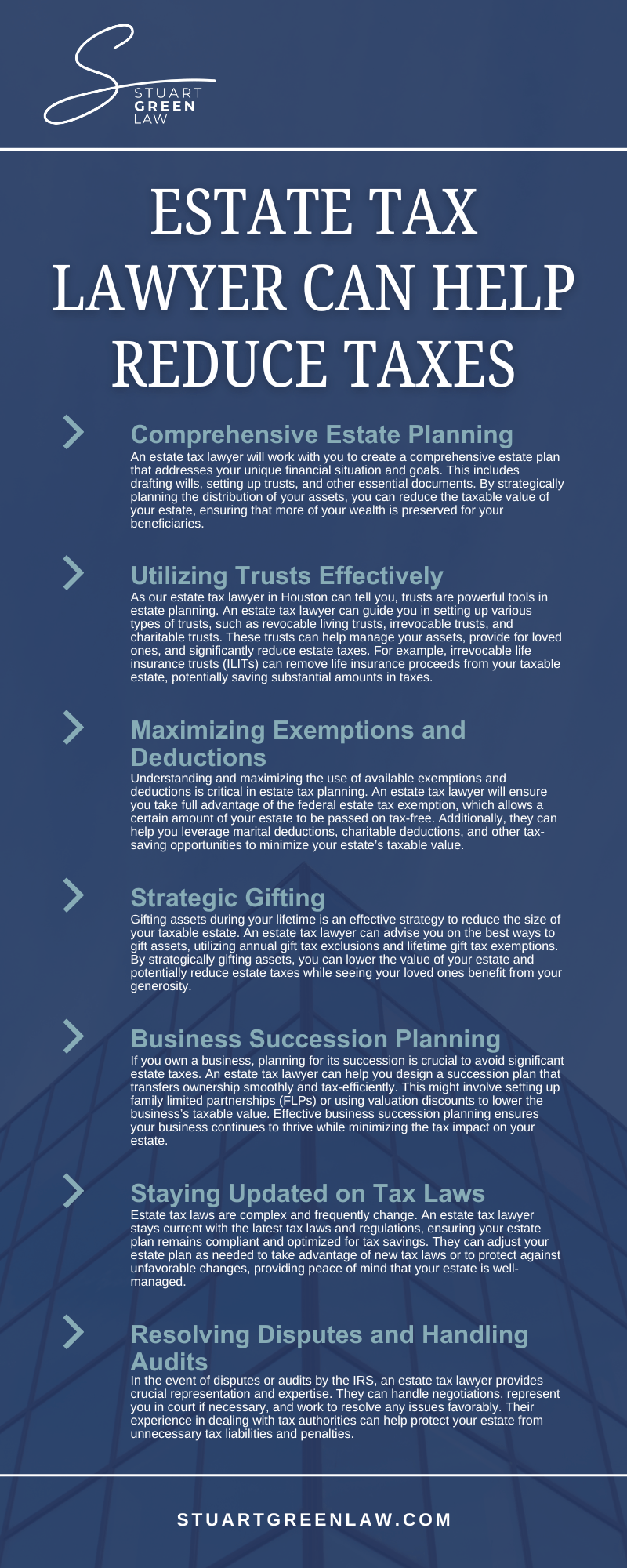
Houston Estate Tax Infographic
What Is Important to Understand About Estate Tax Cases?
Federal Estate Tax Thresholds, Rates, and Exemptions
The federal estate tax is administered by the IRS and governed by the Internal Revenue Code. Several core concepts drive every estate tax case:
- The 2026 federal estate tax exemption is $15 million per individual. Married couples can potentially shield $30 million through portability and proper planning.
- Estates exceeding the exemption face a graduated rate structure with a top rate of 40%.
- The One Big Beautiful Bill Act, signed in 2025, set the $15 million exemption with no sunset provision. It is indexed for inflation going forward.
- Certain assets receive a stepped-up basis at death, which eliminates unrealized capital gains for heirs. Planning must account for both estate tax and income tax effects.
- Texas does not impose a separate state estate tax or inheritance tax. Federal liability is the primary concern for Houston residents.
- Lifetime gifts above the annual exclusion ($19,000 per recipient for 2026) reduce the available estate tax exemption dollar-for-dollar. The IRS requires Form 709 for reportable gifts and Form 706 for taxable estates.
What Are Important Aspects of an Estate Tax Case?
Estate tax cases involve several moving parts, and the complexity often increases with the value of the estate.
Asset valuation is usually the most significant issue. Real estate, closely held businesses, and illiquid investments require professional appraisals. The IRS regularly challenges valuations it considers too aggressive, so getting the number right at the outset is critical to a defensible filing.
Ownership structure also plays a major role. Assets held in joint tenancy, community property, or various trust arrangements are each treated differently. In Texas, community property rules require married couples to pay close attention to how assets are titled and which spouse holds what. The interplay between portability and trust-based planning adds another layer of complexity.
Timing matters as well. Changes in asset values, family circumstances, or federal tax law can all shift the calculus. What made sense five years ago may create problems today. We encourage clients to revisit their estate tax plans regularly.
What Is the Estate Tax Case Timeline?
Every estate tax engagement follows its own path, but the general sequence is consistent.
- Initial consultation and review of the current estate plan, financial statements, prior returns, and family goals.
- Analysis of estate tax exposure under current law and projected asset growth, with modeling across multiple scenarios.
- Strategy design and implementation, which may involve drafting trust agreements, restructuring ownership, or executing gift transactions. Complex plans frequently take several months.
- Ongoing monitoring and updates as circumstances change. We recommend annual check-ins for high-net-worth clients.
- Post-death administration, if applicable, including estate tax return preparation, portability elections, and distribution of assets according to the plan.
What Should You Bring to Your Estate Tax Consultation?
Preparation makes the first meeting far more productive. We ask clients to bring:
- Recent financial statements covering all major assets, including real estate, brokerage accounts, retirement accounts, and business interests
- Existing estate planning documents such as wills, trusts, or powers of attorney
- Prior gift tax returns (Form 709) or estate tax returns (Form 706) if applicable
- Business formation documents and the most recent formal valuation for any company you own
- Life insurance policy summaries, including ownership details and beneficiary designations
These materials allow us to evaluate your situation during the initial meeting rather than spending weeks collecting paperwork. We will walk through your goals, explain where your estate currently stands from a tax perspective, and outline which strategies may apply.
What Are Important Texas Legal Resources for Estate Tax Cases?
Houston residents dealing with estate tax matters can reference several credible sources for general information and further research.
- The IRS estate tax page provides current exemption amounts, filing requirements, and links to all relevant forms.
- The IRS gift tax FAQ addresses annual exclusion amounts, reporting obligations, and common questions about lifetime transfers.
- The IRS estate and gift overview covers filing deadlines, recent legislative changes, and links to both Form 706 and Form 709.
- The Texas State Law Library publishes guides on estate planning and probate law for Texas residents.
Reach Out to Stuart Green Law, PLLC to Schedule a Consultation
If your estate may face federal tax liability, planning ahead is the most effective way to reduce it. Stuart Green Law, PLLC has the background and focus to guide Houston families through this process. Our Houston estate tax lawyer can review your current plan, identify gaps, and recommend strategies that fit your financial situation. Contact us to schedule a private consultation.
Estate Tax Statistics in Houston
 In 2022, families and executors filed 8,130 federal estate tax returns nationwide, a 32% jump over the prior year, according to IRS estate tax statistics. That figure represents a narrow slice of the country. Estate tax filings come from estates large enough to cross the federal exemption, and Tax Foundation data shows that well under 1% of estates ever owe anything at all. Texas imposes no state estate tax and no inheritance tax, so federal liability is the only estate tax exposure Houston residents face. Estates in the region frequently concentrate value in real property, energy holdings, and closely held business interests, categories of assets that often carry a taxable estate above the federal exemption.
Factors That Affect Your Estate Tax Exposure
Two estates of the same dollar value can face very different tax outcomes. The variables below drive most of that difference, and a Houston estate tax attorney weighs each one before recommending a plan.
- The total value of your gross estate. The IRS counts nearly everything you own: real property, bank and brokerage accounts, retirement plans, business interests, and even life insurance you control. The combined total is frequently higher than an owner anticipates. As it approaches the federal exemption, planning becomes worthwhile.
- How your assets are titled. The form of ownership directly affects estate tax treatment. Community property, separate property, joint accounts, and property held in a revocable living trust each carry distinct consequences at death. Assets that pass through probate are administered under the Texas Estates Code, while the tax itself is governed by federal law.
- Lifetime gifts you have already made. Gifts above the annual exclusion reduce the exemption available at death. Careful records of those gifts are essential, because undocumented lifetime transfers can complicate the work of those settling the estate.
- Business interests and their valuation. For an owner, the company is often the largest and least liquid asset in the estate. Valuation, ownership structure, and asset protection planning all influence how much of that value is included in the taxable estate.
- The trust structures already in place. Whether a trust is treated as grantor or non-grantor determines who pays tax on its income and whether its assets fall inside or outside your estate. An incorrect classification can undermine years of planning.
- Probate exposure. Assets that move through the probate process become part of the public record and can slow distribution to your family. Reducing that exposure does not lower the estate tax on its own, but it commonly accompanies the same structures that do.
- Timing. Asset values, family circumstances, and federal law all change over time. A plan built for one exemption level may require adjustment as those variables move, so an estate tax strategy is rarely fixed permanently.
Houston Estate Tax Lawyer FAQs
How much does it cost to work with an estate tax attorney in Houston?
Fees depend on the complexity of the estate and the strategies involved. A plan built around a single residence and retirement accounts looks nothing like one involving a family business, several trusts, and out-of-state property. We talk through scope and structure during a private consultation, so you understand the work involved before you commit to anything.
When should I start estate tax planning?
Earlier planning generally produces better results. Many of the strongest techniques, including gifts and certain irrevocable trusts, are most effective when they have years to operate before death. Waiting until an estate is already large, or until health declines, narrows the available options considerably. If your net worth is nearing the federal exemption, that is the appropriate point to begin planning.
Do I still need an estate tax lawyer if Texas has no estate tax?
Yes. Texas collects no state estate or inheritance tax, but the federal estate tax still reaches Houston residents whose estates exceed the exemption. The absence of a state-level tax simplifies the analysis and cuts one layer of filing. It does not remove the federal exposure that a well-built plan is designed to reduce.
What happens to my plan when the tax law changes?
Estate tax law changes with legislation and shifting federal policy. A structure that was appropriate under one exemption amount can become inefficient when that figure is revised. We build flexibility into the structures we design and recommend periodic reviews so each plan remains aligned with current law.
Can a trust really lower my estate tax?
The right trust can move assets out of your taxable estate while still providing for your family. Different structures do different jobs, from freezing future appreciation to holding life insurance outside the estate. The wrong choice can add liability rather than remove it, which is why matching the vehicle to your specific holdings is the most important consideration. We evaluate what you own, how liquid it is, and what you intend to accomplish before recommending any structure.
Who handles the estate tax return after someone dies?
The executor or trustee is responsible for filing, generally within nine months of the date of death. That person usually coordinates with an attorney and a CPA. Our firm assists fiduciaries with the return itself and with the related income tax returns that come due in the year a person passes away.
What documents form the foundation of a tax-focused plan?
Most plans begin with a valid will, one or more trusts, and powers of attorney, then layer the tax structures on top. Financial statements, prior gift tax filings, and business valuations fill out the rest of the picture. Bringing these to the first meeting lets our attorneys assess your exposure quickly instead of spending weeks gathering paper.
How do I choose the right trustee for a tax-planning trust?
The decision is more consequential than many clients expect. A trustee manages assets, makes distributions, and files returns, and a poor selection can create conflict or personal liability. We advise clients on choosing a trustee and, where appropriate, on professional fiduciary services that bring neutrality and continuity to the role.
What is involved in settling an estate that owes tax?
Settlement means gathering assets, paying debts and taxes, and distributing what remains. When federal tax is due, valuation questions and filing deadlines add pressure during an already difficult period. Our firm guides families through estate settlement and the trust administration that often follows, so that critical deadlines are met.
Local Information for Houston Estate Tax Cases
Harris County Probate Court and Local Resources
Houston is located in Harris County, where much of the administration surrounding an estate takes place even though the federal estate tax is handled through the IRS. The resources below provide reliable starting points for families administering an estate or planning in advance.
What Are Important Local Resources for Houston Estate Tax Matters?
- Harris County Probate Courts, (832) 927-1401. The four statutory probate courts handle will admissions, estate administration, and related matters for county residents.
- Harris County Clerk, (713) 274-8585. The clerk maintains probate filings and real property records and accepts wills for safekeeping during a person’s lifetime.
- Area Agency on Aging, (832) 393-4301. This Houston program provides benefits counseling and caregiver support for residents aged 60 and older and their families.
Stuart Green Law, PLLC is not affiliated with these organizations and does not endorse them. They are listed for general reference only.
About Stuart Green Law, PLLC
Stuart Green Law, PLLC is a boutique estates and trusts firm serving Houston, TX. Before he ever studied law, our founding attorney earned a bachelor’s degree in accounting and a master’s in philosophy, a combination that still shapes how the firm handles both the numbers and the judgment calls in estate tax planning. The practice has also built a distinct focus on South Dakota trust and tax planning, giving Houston families access to some of the most favorable trust laws in the country. Because the firm works only in estates, trusts, and tax, the person answering your questions is the same person designing your plan.
What Our Clients Say
⭐⭐⭐⭐⭐
“Stuart is a competent and professional attorney. He took the time to understand my deeper goals and craft my plan to meet my objectives. I had many questions throughout the process, and Stuart made sure that he explained everything in a way that was easily understandable. It was clear that he’s spent a considerable amount of his career in the estate planning space, understanding nuances, and finding ways to help his clients get the right plan in place. I’m extremely satisfied with his work, and glad that my family is well taken care of with our solid estate plan.” – Chet Collins
Read more reviews on our Google Business Profile.
Contact Stuart Green Law, PLLC
If your estate may exceed the federal exemption, an early assessment of your exposure provides the widest range of planning options. Our Houston estate tax lawyer can review your holdings, evaluate your current plan, and identify the strategies suited to your situation. Stuart Green Law, PLLC represents individuals, families, and business owners throughout Houston, TX and beyond. Contact us to request a private consultation, and our firm will follow up to schedule a convenient time.
The Stuart Green Law Approach
A Modern Approach to Family Wealth
Stuart Green Law combines modern South Dakota trust law with integrated estate planning, wealth management, and fiduciary services for families throughout the United States and internationally. The firm’s approach is built around selecting the strongest legal framework available, maintaining continuity of planning judgment, and bringing every part of the family’s wealth strategy into alignment with its long-term objectives.
Perspectives on Modern Estate Planning
Modern estate planning continues to evolve alongside trust law, tax strategy, wealth management, and family governance. Our articles explore the ideas shaping sophisticated estate planning, providing thoughtful analysis of the legal structures and planning philosophies that preserve wealth across generations.